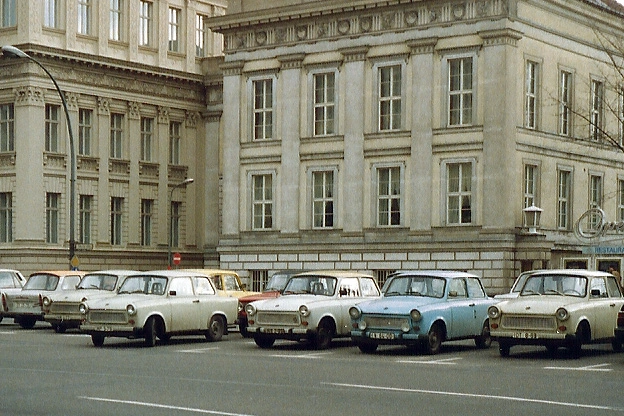
One positive product of the division of Germany was a simple but highly distinctive family car – the jewel of Zwickau, the Trabant. Its name was reputed to come from Middle High German drabant, meaning foot-soldier or companion. Drab by name and appearance it may have been, but the Trabi had bags of character.
When I returned to Berlin in 1988 as the BBC’s stand-in German Language Service representative, aka correspondent, the Trabant quickly became a part of my Alltag or everyday life. If I took the office car over into East Berlin, I was dodging Trabis at every turn. One of my East Berlin acquaintances had a Trabi in which she occasionally gave me a hair-raising lift. No photo of the eastern part of the city was complete without a Trabant – or several – in it.
The Trabi was in many ways an emblem of the DDR (East Germany); some might say a symbolic vehicle. It was cheaply made, functional rather than attractive, noisy and fragile, but it was also unlike any car anywhere else. For its ever-patient owners, DIY Trabi repairs and personalisation often represented small acts of resistance to the uniformity of DDR life.
For reasons that I still cannot fathom, my non-German-speaking mother, living in northern England, would occasionally access shortwave transmissions of the BBC German Service and record them if she heard me, without having the faintest idea what I was saying. I am a bit of a nerd re cleaning up and digitising old/lost recordings, and I therefore know that this (translated into English) is what I wrote about Trabis for the German Service in early 1989. [Brief Aus Berlin, Heute Aktuell 29 January]
East Berlin’s smell precedes it. Any visitor to the eastern part of the city will recall that particular change in the air that hits you when you cross the border. The atmosphere of East Berlin is drenched in the sweet perfume of a particular car exhaust. The Westerner is on the scent of the Trabant, or Trabi – East Germany’s unforgettable small car.
The angular contraption with its body of unbending Duroplast is certainly no beauty. But woe betide any western tourists who consider their VWs or Mercedes to be superior. The Trabi can squeeze into parking spaces the size of a pram. Perched high on its thin wheels, it wobbles through the streets at full throttle and frightening speed. You need to know where you’re going – hesitate for a second and you might have a chattering Trabi in your boot. Even fellow east European countries treat the Trabant with suspicion. Recently Hungary decided to ban its import with effect from 1990, apparently because the emissions from its two-stroke engine are ten times as polluting as those from cars with a four-stroke design.
But despite the scorn that’s ritually heaped upon it, the Trabant is loved tenderly by its owners. And for good reason, since it’s normal to wait for ten years for a new one, and on the used car market – the only recourse for the impatient – you’ll age just as much by looking at the price, which will often be more than an average annual salary.
From my observations I get the impression that every Trabi is trying to stand out from the crowd – and that can rub off on the drivers too. Sometimes literally, as for example the elegantly dressed woman I witnessed arriving at the opera, who stepped into the admiring view of the public through a cloud of carbon monoxide.
Despite their owners’ best efforts, it’s undeniable that most Trabis, even the deluxe models, differ from one another only through which parts of the bodywork are missing or have been replaced. The individuality of each Trabi is asserted in a far more pronounced fashion on the inside. Particularly popular are cushions lovingly embroidered with the Trabi’s registration number, and and soft throws that would not disgrace a living-room. If you look more closely you can tell that some Trabis have changed colour from the current standard uniform blue to a defiant pink or bright green.
A freshly resprayed car can symbolise absolute freedom – or even lead to it, if legend is to be believed. The story goes that one East Berliner who wanted to leave East Germany heard about a Soviet wreath-laying ceremony in the western part of the city. He gave his Trabi a nice new coat of black paint, decorated it with a wreath and allegedly rode into the West in the middle of the Soviet convoy.
It won’t surprise any owner of this perkily hideous little car that the Trabis managed to outlive East Germany itself – and that they did so in many different ways. One Trabant sits in the DDR Museum on Karl-Liebknecht-Straße in Berlin; visitors can treat themselves to an uncomfortable but (because stationary) relatively safe few minutes in its the driving-seat. On Zimmerstraße there’s another, small, museum devoted entirely to the Trabi – positioned fittingly between the Currywurst Museum and what’s left of Checkpoint Charlie. More adventurous visitors to Berlin and Dresden can go on Trabi sightseeing safaris and choose from a zebra-striped or leopard-spotted Trabi, an open-topped Trabi cabrio or – the antithesis of its original purpose – a stretch Trabi limousine. Some providers have introduced the e-Trabi, a testament to the adaptability of the vehicle’s design.
In an earlier outbreak of sightseeing, many West German towns along the former inner-German border were invaded by columns of inquisitive Trabis in the days and weeks following the fall of the Berlin Wall. But some of the little cars were more adventurous still. Early one morning in 1990, I came out of my flat in East London to find a Trabi parked outside. By the evening it was gone, never to return. But in 2023, a plain yellow Trabant was observed to have visited north London for several months, where it enjoyed the freedom of Highbury Fields.
Leave a Reply