What happens when you compare the international anglophone news output of BBC World News TV with that of the English-language Chinese state broadcaster, CCTV-News/CGTN?
If you enjoy a tale of propaganda, journalism, ‘soft power’ and the projection of nations through their media, my book could be of interest to you.
Seeking Truth in International TV News: China, CGTN and the BBC
Reviews of my book:
“Vivien Marsh’s book is an invaluable companion for both scholars and journalists seeking to understand the implications of China’s rise for international journalism.”
Pablo Sebastian Morales, London School of Economics and Political Science, London, UK
“At a time when media narratives and political debates are often ensnared in binary or polarised thinking and vestiges of Cold War mentalities, her nuanced analysis emerges as timely and imperative.”
Hangwei Li, Senior Researcher, German Institute of Development and Sustainability
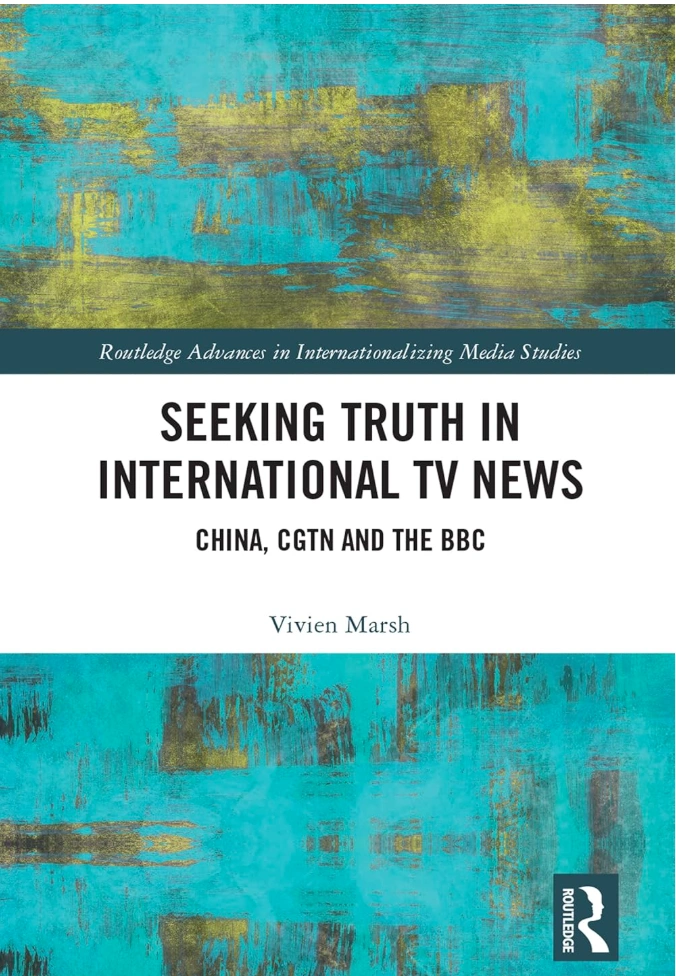
This book puts CGTN (formerly CCTV-News) and the BBC’s international television news head-to-head, interrogating competing ‘truths’ in the exacting business of news reporting.
Written by a media scholar and former long-serving BBC News journalist, Seeking Truth in International TV News asks if China’s English-language television news programmes are little more than state propaganda, and if the BBC can be viewed as a universal news standard to which all other broadcasters should aspire. Over eight years of Xi Jinping’s rule, it investigates how the international TV news channels of CGTN and the BBC reported on Chinese politics, protests in Hong Kong, disasters, China in Africa, and insurgency and its suppression in Xinjiang. The comparison reveals uneven editorial imperatives at the Chinese broadcaster and raises questions about the BBC’s professed tenets of balance and impartiality. It also illustrates how Chinese journalists commit ‘small acts of journalism’ that push the boundaries of information control.
A rigorous analysis of reportage from the two channels, this book will be relevant to scholars of global media, journalism, international relations and public diplomacy. It will also interest those in academia, the media and international affairs who want to examine the nature of news and ‘soft power’ in a comparative context.
Available in paperback, hardback and as an e-book.
Learn more about my book on the New Books Network podcast and in my interview for the China Media Project.
Buy the book (or of course, go to Amazon or a bookseller of your choice).